APTA Private Practice 2026 Annual Conference
All session tools

The EMR Dozen

What 12 implementations taught us about selection, survival and settling

Session #306, Friday, November 13, 2:00 pm

Three tools that follow an EMR change from the decision to look through the audit after go-live. None of them names a vendor; the examples use Vendor A, B and C.

DecidePhase 0
EvaluatePhase 1
SignPhase 2
PreparePhase 3
Go-livePhase 4
StabilizePhase 5
AuditPhase 6
Evaluation Scorecard 90-Day Timeline Template Audit

Gates: contract signed at the end of Phase 2; go/no-go two weeks before go-live.Audit at 90 days, 6 months and yearly.

The tools

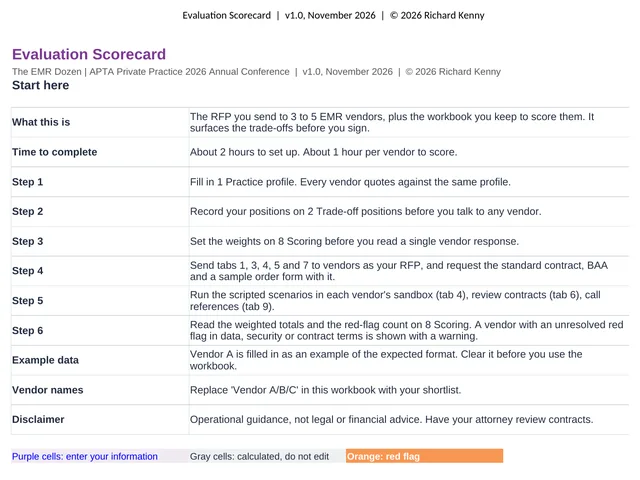
Start here tab of the Evaluation Scorecard

Evaluation Scorecard

The RFP you send to three to five vendors and the workbook you score them in. Every vendor quotes against the same practice profile on the same pricing worksheet. The workbook calculates 3-year total cost of ownership, cost per visit and EMR cost as a share of net collections, and counts the red flags from the session for each vendor. Set your trade-off positions and scoring weights before you read a single response. Allow about 2 hours to set up and an hour per vendor to score.

Tabs: Start here, Practice profile, Trade-off positions, Must-haves, Scenarios, Data and security, Contract, Pricing, Scoring, References.
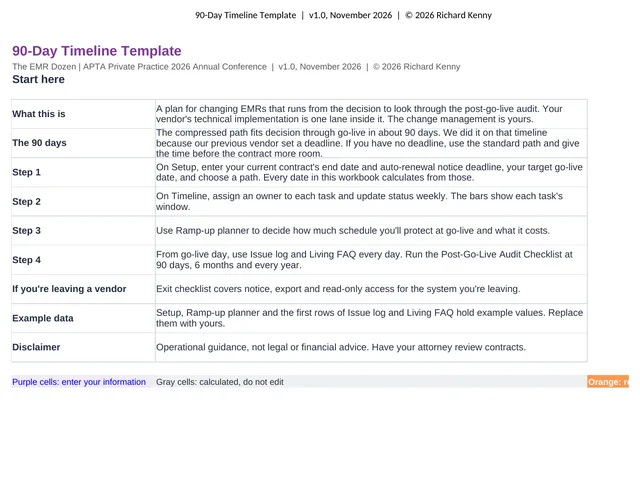
Start here tab of the 90-Day Timeline Template

90-Day Timeline Template

Enter your current contract's auto-renewal notice deadline and a target go-live date, choose the standard or compressed path, and the plan dates all seven phases with owner and vendor lanes. It warns you if signing would land after your notice deadline or if read-only access to the old system ends too soon. The ramp-up planner turns protected go-live time into a budgeted cost.

Tabs: Start here, Setup, Timeline, Ramp-up planner, Issue log, Living FAQ, Exit checklist.

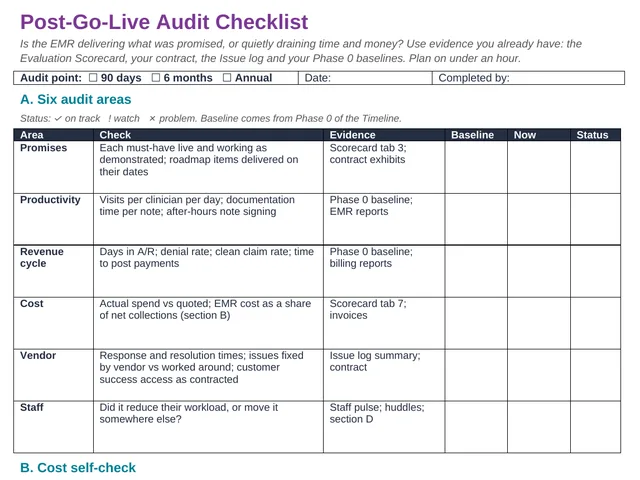
Page 1 of the Post-Go-Live Audit Checklist

Post-Go-Live Audit Checklist

Run it at 90 days, 6 months and every year with the evidence you already have: the scorecard, the contract, the issue log and your Phase 0 baselines. It checks promises, productivity, revenue cycle, cost, vendor support and staff workload, then looks for the silent productivity drains that never show up as tickets. It ends with a decision: on track, fix with the vendor, escalate, or consider leaving.

Before your next EMR decision

Check your EMR cost. Add every seat, add-on and per-use fee for a year, then divide by net collections (cash received). Our derived benchmark is about 0.5 to 1.5 percent, around 1 percent typical. No association publishes a PT figure, so treat it as a reference point. Above 1.5 percent, look at revenue per FTE before you blame the price.

Check your export rights. If your EMR is certified, ask for its 170.315(b)(10) export and the format documentation. If it isn't, put equivalent export terms in the contract.